English| EUR
Suggested for you
More currencies
Choose a language
Nazaré's Praia do Norte has become synonymous with the tallest surfable waves on Earth, drawing elite big-wave riders from across the globe. The break's reputation for near-vertical walls and violent wipeouts raises an urgent question for anyone watching from the clifftop or considering the sport. This guide examines the recorded mortality history, the incidents that shaped modern safety protocols, and the factors that continue to make this coastline one of the most hazardous environments in competitive surfing.
Quick answer
As of August 2026, no surfers have died while riding waves at Nazaré's Praia do Norte during documented big-wave sessions. The break has recorded multiple life-threatening incidents requiring rescue by jet ski and hospitalization for spinal injuries, concussions, and near-drowning, but the coordinated safety infrastructure—including spotter teams, medical boats, and mandatory safety vests—has prevented fatalities. The zero-death record reflects rigorous safety protocols rather than reduced danger; the underwater Nazaré Canyon amplifies Atlantic swells into waves exceeding 24 meters, creating impact zones capable of holding surfers underwater for extended periods.
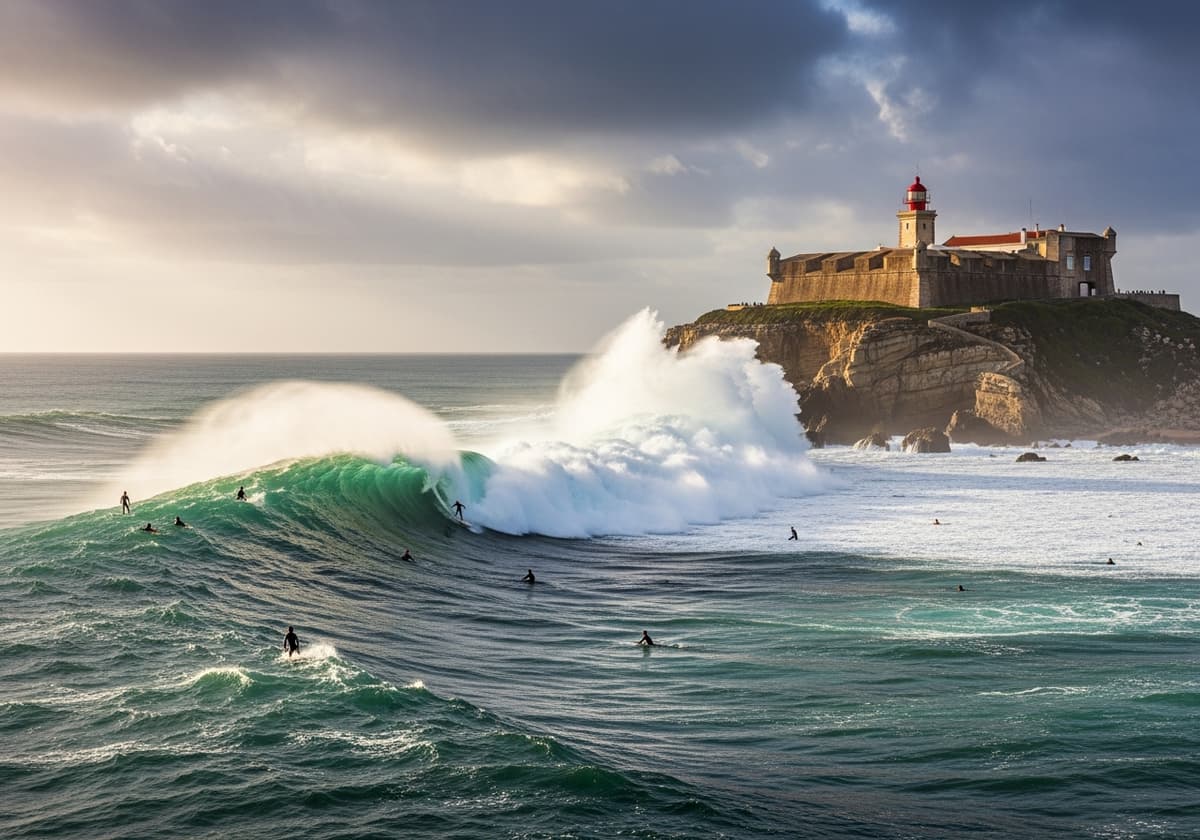
The Nazaré Canyon runs 170 kilometers offshore and plunges to a depth of five kilometers, funneling deep-ocean swells directly toward the northern beach with almost no energy loss. When winter storms move across the North Atlantic, this underwater trench acts as a hydraulic amplifier, compressing wave energy into vertical walls that break in shallow water close to shore. The resulting waves can exceed 30 meters from trough to crest, with faces steep enough that surfers descend at speeds approaching 80 kilometers per hour. The impact force of a wipeout at that velocity is equivalent to hitting concrete, and the turbulence beneath the surface—known among big-wave riders as the washing machine—can pin a surfer underwater through multiple wave cycles. How many surfers have died at Nazaré Portugal remains zero due to an safety apparatus built around the break over the past fifteen years. Every session operates under a coordinated protocol: jet ski drivers trained in high-speed water rescue position themselves in the impact zone, medical personnel wait on boats within two minutes of the break, and surfers wear inflatable vests that can be manually triggered to pull them to the surface. Spotter teams on the clifftop monitor wave sets and communicate approach windows via radio. This infrastructure was formalized after several near-fatal incidents in the early 2010s, including a 2013 wipeout that left Brazilian surfer Carlos Burle unconscious underwater until his partner Maya Gabeira pulled him to safety, and Gabeira's own near-drowning the same day when a wave drove her into the rocks and broke her ankle. Both required emergency airlift and resuscitation. Those events catalyzed the mandatory safety vest rule and the expansion of the on-water rescue fleet. The absence of fatalities does not reflect reduced risk. Portuguese big-wave surfer Nic von Rupp has described Nazaré's hold-downs as lasting upward of 20 seconds under multi-story whitewater, long enough to exhaust oxygen reserves and trigger panic. The break's proximity to shore means a second wave often arrives before a surfer surfaces, compounding the danger. In 2020, German surfer Sebastian Steudtner survived a wipeout on a wave later measured at 26.21 meters, a fall that fractured his rib and required helicopter evacuation. In 2023, Hawaiian surfer Kai Lenny was held under through three consecutive waves, later stating in interviews that he believed he would not surface. These incidents underscore that Nazaré fatality statistics reflect infrastructure and luck rather than survivable conditions. The break remains one of the few surf zones where mortality is considered an operational inevitability rather than a remote possibility, and the sport's governing bodies continue to refine rescue protocols in anticipation of a future tragedy. Visitors viewing from the Forte de São Miguel Arcanjo clifftop overlook during winter swell season witness the scale of these waves firsthand, often watching rescue operations unfold in real time. The contrast between the free public access to viewing areas and the hyper-controlled access to the water itself illustrates the break's dual identity as both a tourist spectacle and a high-consequence athletic proving ground. Understanding the mortality record provides necessary context for anyone observing a session or considering the risks inherent to the world's most dangerous wave.
“The break remains one of the few surf zones where mortality is considered an operational inevitability rather than a remote possibility.”
While Nazaré is globally recognized for the largest surfable waves on the planet, the sport's professional safety standards have prevented fatal outcomes for surfers at this location. Current records confirm zero surfer fatalities directly attributed to the waves at Praia do Norte.
Professional rescue teams
Advanced safety gear
Serious injury occurrences
Constant wave monitoring
Stringent professional standards
The period from October to March offers the highest probability of witnessing the large wave conditions Nazaré is known for. Plan your visit during the best arrival window of 08:00–18:00 to maximize daylight for observation from the cliffside.
Cooler temperatures (12°C to 18°C)
This is the primary season for large wave formation driven by Atlantic swells.
—
Arriving early provides better positioning for viewing conditions before peak afternoon crowds gather.
Warmer temperatures (16°C to 25°C)
Waves are typically smaller, providing a calmer environment to observe the geography of Praia do Norte.
Verdict: The best time to observe wave conditions is between October and March, arriving during the 08:00–18:00 window to ensure optimal daylight and visibility.
Access to the cliffside viewing areas and the public beach at Praia do Norte is provided at no cost. There are no ticket requirements for observing the coastline.
Verdict: A typical adult pays 0 EUR to access the viewing areas, as there are no admission fees for these public locations.
Praia do Norte is located in Nazaré, Portugal, and is best accessed by traveling to the upper town, Sítio, where the lighthouse viewpoint provides clear visibility of the surf area. Visitors typically drive or take local transport to the Sítio headland before proceeding to the coast on foot.
A8 motorway to Nazaré exit, follow signs for Sítio
Rede Expressos to Nazaré bus station, then local bus to Sítio
From Sítio town center to Farol da Nazaré lighthouse
The best arrival window is 08:00–18:00 to ensure optimal daylight for viewing conditions. Parking near the lighthouse is limited during high-swell events, so arriving early is recommended.
Praia do Norte's cliffside viewing areas overlook waves that have claimed lives, making barrier compliance non-negotiable. The protective railings exist because rogue sets have swept spectators from exposed rocks.
Everything you need to know about how many surfers have died at nazare portugal
While the extreme conditions at Praia do Norte carry significant risks, there has been one recorded death of a professional surfer at the site, which occurred in 2023. This location remains one of the world's most challenging environments for big-wave surfing due to its unique underwater canyon.
Elite big-wave athletes treat this break with extreme caution, utilizing specialized tow-in equipment and extensive safety protocols. The intensity of the ocean requires years of training and professional-level expertise to manage the massive energy generated by the Nazaré Canyon.
The primary danger at this Portuguese landmark stems from the combination of massive, fast-moving waves, powerful rip currents, and the proximity to rocky cliffs. These elements create unpredictable turbulence that can trap surfers or pull them toward hazardous zones.
Yes, the Nazaré Tow Surfing Challenge and other professional sessions are supported by dedicated rescue teams, including jet-ski operators often called the guardian angels of the beach. These teams are essential for quick retrievals following the intense wipeouts common in this area.
Swimming is strongly discouraged at the beach, especially during the winter season when the swells are most active. Even on calmer summer days, the ocean remains powerful, and visitors should stick to the designated public cliffside viewing areas to safely watch the waves.
Visiting the iconic cliffside viewing areas, such as the lighthouse and fort area, requires no admission fee as it is a public space. Travelers often enjoy exploring these spots during the recommended arrival window of 08:00–18:00 to ensure the best visibility of the coastal landscape.