
English| EUR
Suggested for you
More currencies
Choose a language
Nazaré's famous giant waves follow a tight seasonal window tied to North Atlantic storm systems. Understanding when biggest waves in Nazare form—and why some winters deliver record swells while others stay quiet—turns a speculative trip into a calculated visit to one of surfing's most extreme proving grounds.
Quick answer
The biggest waves in Nazaré arrive between November and March, with peak activity from late December through February when North Atlantic winter storms generate swells that can exceed 80 feet. The Nazaré Canyon—a 16,000-foot-deep underwater trench—funnels and amplifies ocean energy toward Praia do Norte, creating conditions found nowhere else in Europe. Not every day delivers giants; the largest waves require a precise alignment of deep low-pressure systems, long fetch distances, and favorable wind direction.
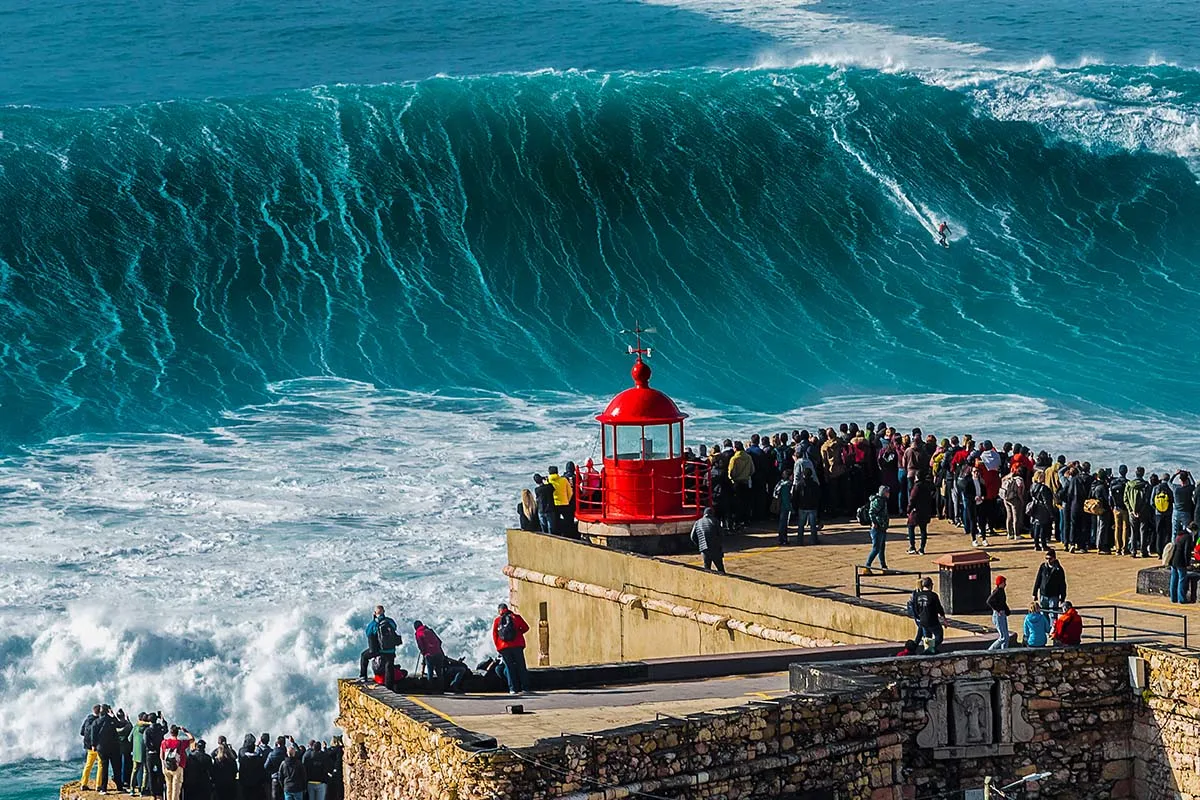
The Nazaré Canyon runs 125 miles offshore and plunges nearly three miles below the surface, deeper than the Grand Canyon and positioned perpendicular to the coast. When Atlantic storm systems track across this underwater gorge during winter months, wave energy compresses and accelerates as the canyon narrows toward shore, transforming open-ocean swells into towering walls of water at Praia do Norte. This bathymetric anomaly is why Nazaré holds multiple big-wave surfing records while beaches just ten miles north and south remain comparatively calm during the same swells. When biggest waves in Nazare arrive depends on storm latitude and trajectory. Low-pressure systems between 45°N and 55°N—roughly between Newfoundland and Iceland—generate the longest fetch and most powerful groundswells. These storms must maintain winds above 40 knots for at least 24 hours and track eastward across deep water to build the period and size that produce record waves. December through February offers the highest frequency of such systems, but November and March can deliver comparable swells when conditions align. Local wind matters: offshore or light winds from the east hold wave faces upright, while onshore Atlantic winds create choppy, less rideable conditions even when underlying swell energy is massive. The Forte de São Miguel Arcanjo lighthouse sits directly above the break at Praia do Norte and serves as the primary observation point during big swells. On Code Red days—when waves exceed 50 feet—access to the beach below is closed and crowds gather along the fort's seaward ramparts. Surfers rely on detailed swell models updated twice daily, tracking storm positions four to six days out and calculating arrival windows based on wave period and direction. A 20-second period swell traveling from 310 degrees will hit the canyon differently than a 16-second swell from 290 degrees, even if both carry similar energy. This is why the Nazaré big wave season is never guaranteed week to week; it is a narrow meteorological corridor where three variables—storm intensity, trajectory, and local wind—must converge. Most winter visitors targeting giant surf monitor forecasts for at least two weeks and remain flexible, ready to move plans forward or back by several days when a significant swell enters the five-day window.
“The Nazaré Canyon compresses open-ocean energy into walls of water found nowhere else along the European Atlantic coast.”
The Nazaré big wave season occurs during the North Atlantic winter, typically running from October through March. During this period, deep-sea storm systems generate the swells required for the legendary waves at Praia do Norte.
Mild, 15°C to 20°C
Early season swells begin as Atlantic storm systems become more active. Surface conditions are often favorable for surf observations.
Cool and wet, 10°C to 15°C
This period holds the highest statistical probability for massive wave events. Storm frequency peaks, often resulting in larger swell intervals.
Variable, 12°C to 17°C
Swell activity remains consistent, though the season begins to taper off by month-end. Weather transitions toward spring conditions.
Verdict: The best window for observing the largest swells is mid-winter, specifically from December through February.
The Forte de São Miguel Arcanjo, which serves as the primary vantage point for observing the waves in Nazaré, maintains consistent daily access hours throughout the week.
The primary vantage point for observing the biggest waves is the Forte de São Miguel Arcanjo, located at Estrada do Farol, Sítio, 2450-065 Nazaré, Portugal. The most practical approach is via the Sítio district, which sits on the cliff overlooking the lighthouse.
A8 motorway to exit 22 (Nazaré) then follow signs to Sítio
Rede Expressos to Nazaré Bus Station then local bus to Sítio
Walk from Nazaré town center via the funicular or cliff path
The best arrival window is 09:30–10:00. Arriving early helps avoid the heavy crowds and parking issues common on big wave days.
Big-wave days at Nazaré demand preparation for wind, crowds, and limited mobile connectivity.
Everything you need to know about when biggest waves in nazare
The best time to visit and discover when biggest waves in nazare occur is during the winter season, specifically from October to March. Atlantic storms during these months generate the massive swells that define the local surfing culture.
While the winter months offer the highest probability, giant swells are natural phenomena and not guaranteed during every visit. Checking the local surf forecasts is essential when planning your trip to see when biggest waves in nazare are expected.
You can certainly visit the Forte de São Miguel Arcanjo, which serves as a prime viewpoint for the surf, and explore our buggy tours to reach the area comfortably. Our site helps you plan your visit to the lighthouse and surrounding landmarks without selling tickets directly.
The entrance fee for the Forte de São Miguel Arcanjo museum is 3 EUR. This fee allows you to explore the interpretive center and historical exhibitions inside the fort.
The fort is open daily from 09:30 to 20:30, including weekends. Arriving early between 09:30–10:00 helps you avoid the heavy crowds and parking issues common on big wave days.
Even outside the winter season, the site remains a significant historical landmark and a scenic spot for coastal views. It is a great location to learn about the geological formations that cause the waves, even when the ocean is calm.